Herpetology
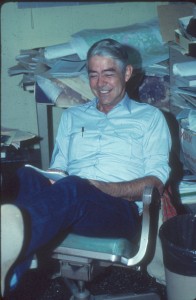 Robert H. “Bob” Mount
1968-1986
BS Auburn University
MS Auburn University
PhD University of Florida
The majority of collections growth at Auburn University occurred during the tenure of Dr. Robert H. Mount. Bob was born in Tennessee, raised in Georgia, and spent significant time in Auburn as a student, where he met his life-long colleague, Dr. Dan Speake. So, by the time Bob finished his doctorate and accepted his first faculty position at Montevallo College, his understanding of the flora and fauna of the southeastern United States was expansive. Red Arant, the head of the Department of Zoology and Entomology at Auburn, hired Bob away from Montevallo in the fall of 1966.
Bob’s main teaching assignment was Vert Zoo 1 (introduction to fishes, amphibians, and reptiles) and Herpetology. As part of the Herpetology course, he required a collection, the quality and quantity of which served as a major portion of the total score for lab. Through this mechanism the herpetological holdings increased exponentially. The course involved two labs each week, one for examining materials in the teaching lab and one for exploring the local fauna in the field. During the field labs no vans were available for instructional travel, so students had to be willing to carpool to remote sites to participate in the labs. Bob’s stated goal during these trips was to give students deep, enriching experiences with amphibians and reptiles and many stories verify that this was the case.
The collections remained in Funchess Hall during Mount’s curatorship and became a hub, perhaps the hub, of research activity in that building. During Mount’s era extensive live collections were a constant component of the museum. As a result, Funchess Hall was inundated by fans on football weekends who visited the “snake room” as a favorite pre-game activity. Additionally, the local populace, especially the campus and Auburn police, took advantage of the services of Bob and his students in removing live snakes from their yards. A final use of the collections was for animal shows at local grade schools and scout troops. This outreach activity was felt throughout the state and served as great PR for department.
A total of 19 graduate students performed research in Mount’s lab and the group was notorious for their devotion to field research. That devotion meant that the collections space was in constant use, day and night. The stories of ill-fated activities in the lab are voluminous, but can be characterized from a story written by Mount as part of his weekly column in the local paper. In that story a coral snake escaped in the lab setting off a frenzy of activity to find it. The initial frenzy yielded no snake and Bob began contemplating whether it was best to keep silent about the escapee or whether to approach Dr. Arant with the news, knowing what disruption this would cause the entire building. Fortunately, during a final search of the lab, a large piece of furniture was moved, revealing the nest of an escaped rat and the unmistakable tail end of the escaped snake, which had been consumed by the rat.
Mount’s research focused on understanding Alabama’s rich herpetofauna and on its preservation for future generations. As part of these studies he and his students produced important research on patterns of speciation within the state (e.g. Schwaner and Mount 1976; Occ. Papers of the Museum of Natural History Univ. Kansas 45:1-44) and life history of rare species (e.g. Hanlin 1978; Copeia 1978:358-360). Two species within Alabama, the Red Hills Salamander (Phaeognathus hubrichti) and the Flattened Musk Turtle (Sternotherus depressus) were protected under the Endangered Species Act, largely based on population studies performed by Mount and his students. Bob’s devotion to conservation placed him at odds with timber and coal interests in the state, both of which eventually, and grudgingly, supported efforts to conserve these and other sensitive taxa. Through Bob’s vision, a recurring set of conferences has been convened to review the state’s biota and to assess its status for conservation planning. This series commenced with the Red Book (Vertebrate Animals in Need of Special Attention) published by the Alabama Agricultural Experiment Station, a volume edited by Bob.
The collections numbered about 5000 individuals when Mount inherited them. When he retired, they had grown to about 35,000 specimens and were widely recognized as the premiere library for the state’s herpetofauna. In retirement, Bob has maintained an active association with the collections by weekly visits to the herpetology lab where he serves as a vital resource of life history information of Alabama amphibians and reptiles and as a source of stories about the old days. The bottom line is that, during Mount’s era, his graduate students felt a special kinship from having survived their field experiences and the lively social environment of the herp lab that Bob created.